%20(1).png?width=200&height=200&name=Untitled%20(200%20x%20200%20px)%20(1).png)
Update, 2 October 2026: new Student visa rules now apply
The Migration Amendment (Student Visa Reform) Regulations 2026, LIN 26/102 and LIN 26/087 commenced on 2 October 2026. For Student visa applications made on or after that date:
- holders of visitor, working holiday, work and holiday, Temporary Graduate (485), 482, 457, 407, 408 and several other temporary visas must apply from outside Australia;
- most current Student visa holders must also apply from outside Australia, unless an exemption applies, such as completing the current course within 12 months of its end date, progressing to a higher qualification level, doctoral study or provider default;
- family members can only be included if an exemption applies (for example an eligible Pacific or ASEAN passport, Defence or Foreign Affairs students, doctoral students, or a course fully funded by a foreign government), and family members can no longer apply later as subsequent entrants, apart from a child born in Australia.
Applications made before 2 October 2026 continue under the earlier rules. Parts of this article written before that date may not apply to new applications. See the current summary on our Student visa page. General information only, not advice for your circumstances. Migration Star, Rohit Sharma, Registered Migration Agent, MARN 1797395.
Update, 11 October 2026: Direction 119 has been replaced
The Department of Home Affairs states that Ministerial Direction No. 119 was replaced in full from 19 September 2026 by Ministerial Direction No. 121 (temporary skilled visas, including Subclass 482 Skills in Demand) and Ministerial Direction No. 122 (provisional and permanent skilled visas, including the Employer Nomination Scheme). References to Direction 119 in the sequencing section below describe the position before that date. Priority is a position in a queue, not a promise of speed or outcome. See the Department's skilled visa processing priorities page.
Finishing an Australian qualification is the point at which a lot of carefully made plans go vague. The subclass 485 temporary graduate visa is usually the bridge between study and whatever comes next, but it is a bridge with a strict entry window, an age limit, and two streams that lead to very different lengths of stay. It also cannot be extended. This guide covers who each stream is for, what the Department requires at the time of application, how long you get and why, and how to sequence the step after the 485 so the timing works in your favour.
What the Subclass 485 Temporary Graduate Visa Is and Who It Is For
The subclass 485 is a temporary visa for international students who have recently completed an Australian qualification. It allows you to live, study and work in Australia temporarily after you have finished your studies, and you can include members of your family unit in the application.
Two features shape almost every decision around it. You must be in Australia when you apply, though not at immigration clearance. And you must have held a Student visa in the last six months. That six-month window is the practical deadline that catches people out, particularly graduates who go home for a break after their final results and plan to sort the visa out later.
There is no employer sponsorship and no nomination involved. The Department is explicit that you must find your own employment while on this visa. It is permission to be in Australia and work, not a job placement scheme.
Post-Higher Education Work Stream Versus Post-Vocational Education Work Stream
The stream you apply under is decided by your qualification, and the gap between the two is significant.
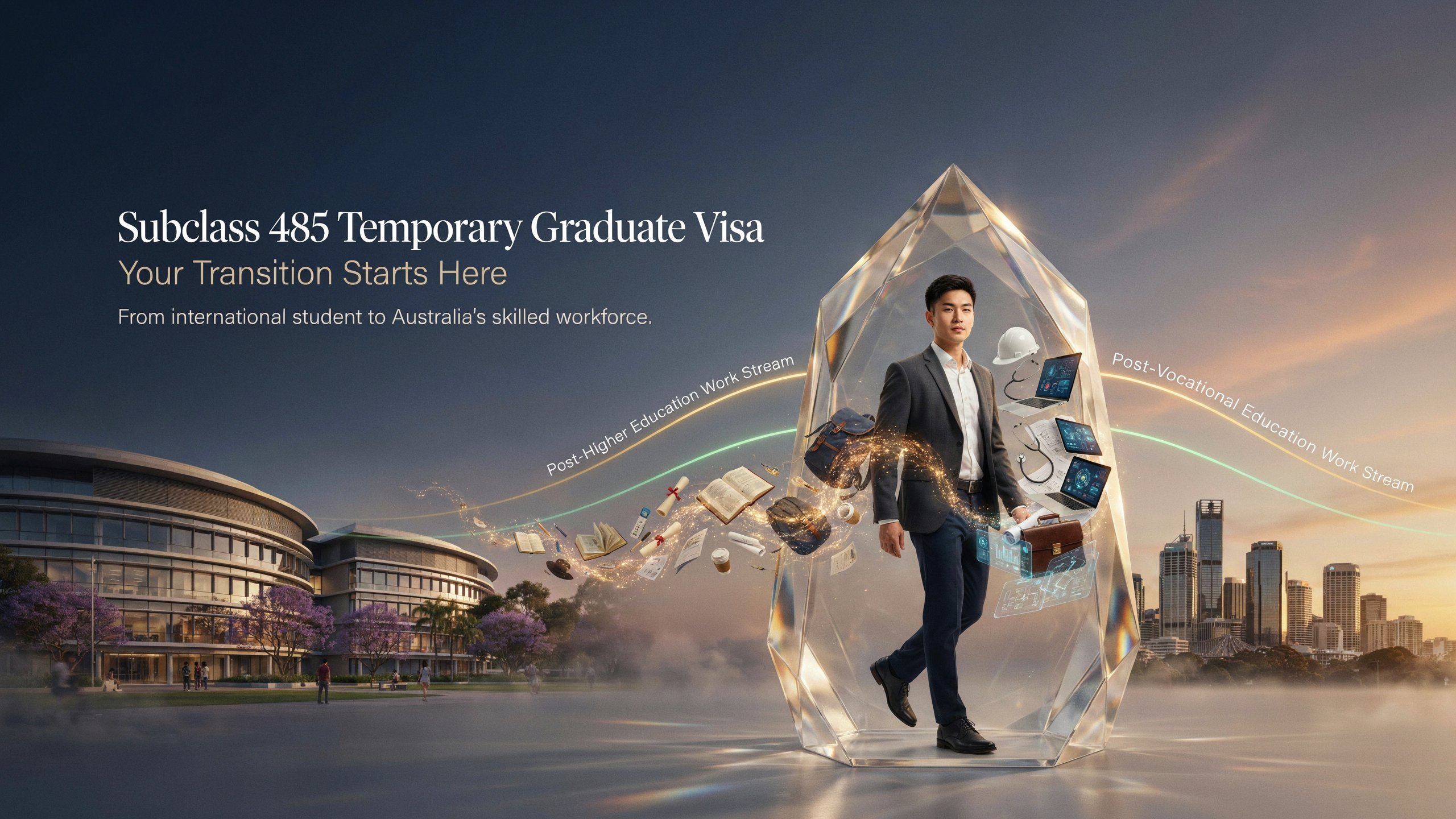
Post-Higher Education Work Stream. This is for international students who have recently graduated with a degree from an Australian institution. The Department describes the stay as usually between two and three years, depending on your qualification. There is no skills assessment requirement to enter this stream and no requirement that your field of study match a skilled occupation list.
Post-Vocational Education Work stream. This is for graduates with an associate degree, diploma or trade qualification relevant to an occupation Australia needs. Stay here is up to 18 months. Critically, this stream carries two extra requirements that the degree stream does not: your qualification must be relevant to an occupation on the skilled occupation list, and you must have applied for a skills assessment in your nominated occupation on that list.
That second point is where vocational graduates most often lose time. The skills assessment application has to have been made before you lodge, so the assessment timeline needs to sit inside your six-month post-Student visa window. If you hold a vocational qualification and have not yet contacted your assessing authority, that is the first thing to move on.
Age, Study and English: The Core Subclass 485 Eligibility Criteria
Both streams share a common eligibility spine. You must:
- Be aged 35 years or under when you apply, though the Department notes that exceptions apply
- Be in Australia when you apply for this visa
- Hold an eligible visa
- Have held a Student visa in the last six months
- Provide evidence of the required level of English with your application
- Provide evidence of adequate health insurance for all applicants when you apply
- Provide evidence you have applied for an Australian Federal Police check when you apply
For the Post-Higher Education Work stream, you must additionally hold an eligible qualification at degree level or above, meet the Temporary Graduate visa study requirement, and have studied with an Australian education provider in a CRICOS-registered course. The Department's full criteria list for that stream also covers the health requirement, the character requirement, signing the Australian values statement, having no debt to the Australian Government, and not having had a visa cancelled or an application refused.
The word "evidence" is doing real work in three of those points. English, health insurance and the AFP check are not things you sort out later. The Department wants proof with the application, and the insurance must cover every applicant, not just you.
Health Insurance, AFP Clearance and the Documents That Most Often Delay a Grant
The Department is direct about what slows an application down. Processing can take longer if you do not fill the application in correctly, if it needs more information from you, or if it takes time to verify your information. It cannot process an application where the correct visa application charge has not been paid, and will notify you and, if necessary, return the application.
The visa costs AUD5,750.00 for the main applicant, with a further charge for each family member who applies with you. That figure is current as at 26/08/2026 and should be checked against the Department's Visa Pricing Estimator before you lodge. A lower charge applies to eligible Pacific Island and Timor-Leste citizens, including Papua New Guinea passport holders. The Department does not publish a concession figure on the stream pages; it applies the lower charge in ImmiAccount based on the passport used, and directs applicants to its Visa Pricing Estimator to work out what a specific application will cost.
A short list of the practical traps:
- AFP check. You need evidence you have applied for it, so lodge the AFP request early and keep the receipt.
- Health insurance covering everyone. A policy covering only the primary applicant is a common and avoidable gap.
- The six-month window. Count it from your last Student visa, not from your graduation ceremony.
- Family timing. You can include family unit members if they are in Australia. Children can be added up until the Department decides, but no other family member can. After grant, they apply as subsequent entrants and pay the full visa application charge.
- Name and document consistency. Names must match your passport exactly, all previous names must be disclosed, and non-English documents must be translated, with a NAATI practitioner number if translated in Australia.
If your student visa work conditions are part of the picture while you wait, our guide to the 48-hour fortnight under condition 8105 is worth a read, and if you will be on a bridging visa between lodgement and decision, our bridging visa explainer covers what you can and cannot do in that period.
How Long You Get on a Subclass 485 Visa, and Why Your Qualification Decides It
The Department puts the principle plainly:
"This is a temporary visa. The length of your stay in Australia will depend on the level of your Australian study qualification." Department of Home Affairs, Temporary Graduate visa (subclass 485), Post-Higher Education Work stream
For the Post-Higher Education Work stream, the published periods are:
- Bachelor degree, including honours: 2 years
- Masters by coursework, and extended masters: 2 years
- Master's by research: 3 years
- Doctoral degree: 3 years
- Graduate Diploma: 2 years by default, but may be longer where previous study would have attracted a longer stay period
Nationality changes this for two groups. For Indian nationals, the periods agreed under the Australia India Economic Cooperation and Trade Agreement are two years for a bachelor degree including honours, three years for a bachelor degree with first class honours in STEM including ICT, three years for master's degrees whether coursework, extended or research, and four years for doctoral degrees. Those periods apply to the Post-Higher Education Work stream only.
Separately, Hong Kong and British National Overseas passport holders may stay up to five years under either stream, and the Department notes that current and future Temporary Graduate visa holders from Hong Kong may have a pathway to permanent residency after five years.
Two things follow. The visa starts on the date it is granted, not the date you finished studying, so a delayed lodgement is time you do not get back. And it cannot be extended. You may be eligible to apply for a Second Post-Higher Education Work stream visa, but that is a separate application against separate criteria. You can travel in and out while the visa is valid, but time spent outside Australia does not extend it.
What Comes After the Subclass 485: Sequencing Your Skills Assessment and Next Application
This is the section worth planning backwards from, and it is worth being accurate about one point that is currently being misreported.
Ministerial Direction 119 commenced on 25/07/2026 and now orders processing for skilled nomination and visa applications by nominated occupation and by whether the applicant was in Australia at the time of application. Subclass 485 is not one of the subclasses covered by that direction. Schedules A and B list subclasses 186, 187, 189, 190, 191, 482, 489, 491, 494, 887 and 888. Your 485 application is not ordered by MD 119.
Where the advantage lies is the step after. If you make your subclass 482, 190 or 491 application while you are in Australia, you sit in a higher priority band than an equivalent applicant who is offshore at the time of application. Under the published order, applicants already in Australia rank above those outside Australia, and construction, healthcare and teaching occupations sit above other occupations in the onshore bands. The full order is on the Department's skilled visa processing priorities page.
The practical sequencing, then, looks like this:
- Lodge the 485 inside the six-month window so the clock starts as early as possible
- Obtain a skills assessment in an occupation you can realistically nominate, if you do not already hold one
- Build documented skilled employment in that occupation. For skilled applications, the Department asks for payslips, bank statements and tax statements, and says a work reference alone is not enough. See Applying for a skilled visa
- Time the next application so it is made while you are in Australia and while your 485 still has room in it
None of this guarantees an outcome, and priority is a position in a queue rather than a promise of speed. But a graduate who plans this from month three usually ends up with options, and one who starts in the final six months usually ends up with one.
Where Migration Star Can Help
Migration Star is a Brisbane-based registered migration practice working with graduates across Australia, and our principal agent Rohit Sharma holds MARN 1797395. We can confirm which stream you fall under, check your six-month window and age position before you commit to a plan, and map the steps after the 485 so the timing works rather than fights you. We do not promise outcomes, because outcomes depend on your circumstances and on meeting Department requirements. You can see our full range of services or book a session with us to talk it through.
Free written eligibility assessment: https://www.migrationstar.com.au/eligibility-assessment
Book a consultation (30 minutes AUD 165 or 1 hour AUD 330, incl GST, credited against our fees): https://www.migrationstar.com.au/book-a-consultation
Phone: 07 3519 5619 Office: Level 2, 8 Clunies Ross Court, Eight Mile Plains QLD 4113
Information current as at 26/08/2026. Migration Star is a registered migration practice. Principal agent Rohit Sharma, MARN 1797395. Migration outcomes depend on individual circumstances. Visa criteria may change. This article is general information only and does not constitute migration advice. For advice on your specific situation, book a consultation at migrationstar.com.au.
Migration Star | MARN 1797395 | migrationstar.com.au | 07 3519 5619