If you are in a relationship with an Australian citizen, permanent resident or eligible New Zealand citizen, one of the first questions is where you will be when you lodge. The answer decides which visa you apply for, and it matters. This guide explains the onshore vs offshore partner visa Australia choice in plain language, including the partner visa 309 vs 820 difference, how the Department prioritises applications, and when the permanent stage is assessed. It is general information only, and every couple's circumstances differ.
Onshore vs offshore partner visa Australia: the basic split
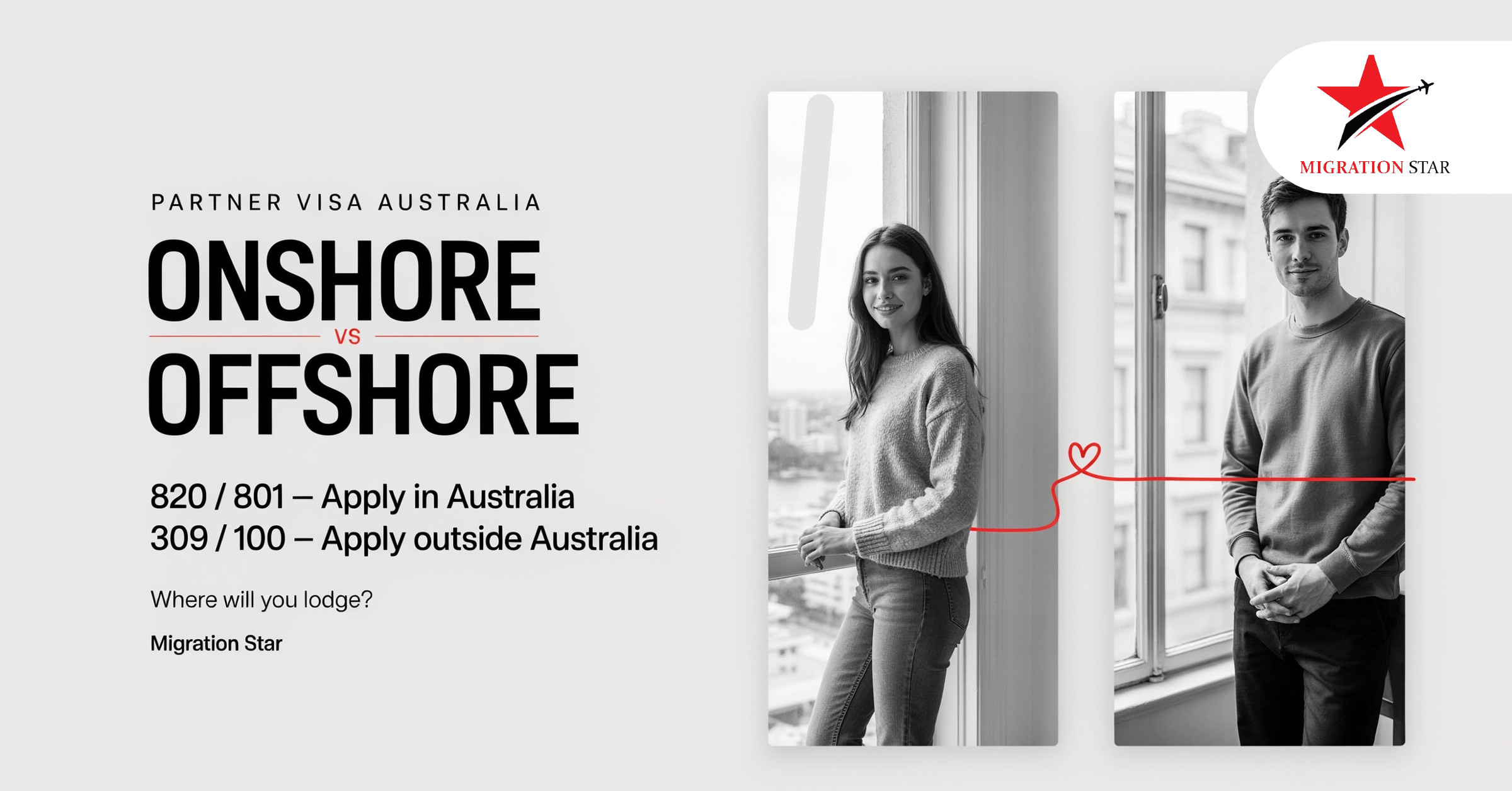
Home Affairs describes two two-stage pathways. If you are in Australia when you apply, the pathway is the Partner (Temporary) visa (subclass 820), followed by the Partner (Permanent) visa (subclass 801). If you are outside Australia, it is the Partner (Provisional) visa (subclass 309), followed by the Partner (Migrant) visa (subclass 100).
The Department's About partner visas page states that you must be in Australia to apply for the subclass 820, and that "Getting this visa is the first step towards a permanent Partner (Permanent) visa (subclass 801). The subclass 309 and 100 are presented as the offshore pair.
So the first practical question is simple: where will you physically be on the day you lodge?
Who can apply: the 820, 801, 309 and 100 visas
According to Home Affairs, the 309, 100, 820 and 801 visas cover the spouse or de facto partner of a sponsor. The sponsor must be an Australian citizen, an Australian permanent resident or an eligible New Zealand citizen.
There is also a Prospective Marriage visa (subclass 300) for people who want to come to Australia to marry a prospective spouse. You must be outside Australia when you apply for it, and after the marriage you can apply for a Partner visa.
The Department's page does not set out further sponsor requirements, so any couple considering lodging should read the current Partner Program information on the Home Affairs website or get advice before assuming the sponsor qualifies. Eligibility is assessed against the visa criteria in force at the time of lodgement, and a person may be eligible only if they meet every criterion.
Partner visa 309 vs 820 difference: what really changes
The core difference is location at lodgement, but the practical effects reach further. These are the points the Department's own pages support:
-
Where you apply from. The subclass 820 is lodged in Australia; the subclass 309 is lodged outside Australia.
-
Which permanent visa follows. The 820 leads to the 801; the 309 leads to the 100.
-
Priority in the queue. Under Ministerial Direction 117, onshore applications receive the highest priority and some offshore applications receive lower priority (covered in the next section).
-
Where you are during processing. The 309 lets you live in Australia temporarily once granted, as described on the Department's page.
Just as important, the visa you choose should match your real situation. For example, a person who is outside Australia cannot lodge an 820, and a person already in Australia may not wish to leave to lodge a 309. Our team looks at your current visa, travel plans and timing before suggesting a lodgement strategy.
Ministerial Direction 117 and partner visa priority
The Department's Partner visa FAQs explain how applications are ordered. Applications are generally assessed in the order received under Ministerial Direction 117, and onshore applications receive the highest priority. The page says "Lower priority is given to offshore applications for" the Prospective Marriage visa (subclass 300) and the Partner visas (subclass 309 and 100).
The same page notes that lower-priority applications are likely to take longer. We have not quoted any processing time here, because Home Affairs updates its figures regularly and the current numbers are best read directly from the Department's website on the day you plan to lodge.
Priority is only one input into your decision. A couple should also weigh their current visa position, any planned travel, and whether living apart during processing is realistic. You can browse our earlier explainers on processing priority at migrationstar.com.au/blog, and we are happy to talk through how the direction applies to your own file.
The permanent stage: Stage 2 and the two-year rule
Both pathways are two-stage. The FAQs state that if you hold a temporary Partner visa (subclass 309 or 820), "two years must have passed since you applied for that visa to be eligible for assessment of the permanent visa." Once you are eligible, you lodge through ImmiAccount by selecting "Stage 2 - Permanent Partner Visa Assessment (100, 801)."
Two practical points follow. First, the two years run from when you applied for the temporary visa, not from when it was granted. Second, the Department refers applicants to the visa requirements pages for the full eligibility criteria at Stage 2, so you should read those closely before the date arrives. Holding a temporary visa does not by itself guarantee that the permanent visa will be granted.
Questions couples ask before choosing a pathway
Can we decide later? Not really, because the pathway follows where you are when you lodge. Does an onshore application mean a permanent visa straight away? No. The Department describes the 820 as the first step towards the 801, and the permanent stage is assessed separately once the two-year point has passed. Is the offshore route a lesser option? Not necessarily; it is simply the pathway designed for applicants outside Australia, and some couples have good reasons to use it.
The right answer depends on your visa history, your sponsor's status and your timing, so treat any general guide, including this one, as a starting point rather than a recommendation.
Getting your application ready: health and character
Whichever pathway you take, the Department can request supporting documents after lodgement. Two areas deserve early preparation. Character: read our guide to the character requirement and Form 80, because the Department may ask for a Form 80 or a police certificate after lodgement, and having them ready helps. Health: see our explainer on visa medical examinations so you know what to expect.
The Subclass 820 page on the Home Affairs website sets out eligibility, requirements and application steps for the onshore visa. Check it on the day you lodge, as the Department updates these pages from time to time (the page was last updated on 12/10/2026 when we reviewed it, at this Home Affairs page).
Where Migration Star Can Help
Choosing between an onshore and an offshore partner visa is a decision that is easier to make with someone who has seen your whole situation. Migration Star is a registered migration practice in Brisbane; our principal agent is Rohit Sharma, MARA No. 1797395. We can review your visa history, timing and documents and explain your options under the current rules, without promising any outcome. You can learn more about our partner visa and other services, call us on 07 3519 5619, or visit us at Level 2, 8 Clunies Ross Court, Eight Mile Plains QLD 4113. Book a 30-minute Migration Consultation ($165) at https://www.migrationstar.com.au/book-a-consultation
Information current as at 28/10/2026. Migration outcomes depend on individual circumstances. Visa criteria may change.
Information current as at 28/10/2026. Migration Star is a registered migration practice. Principal agent Rohit Sharma, MARA No. 1797395. Migration outcomes depend on individual circumstances. Visa criteria may change. This article is general information only and does not constitute migration advice. For advice on your specific situation, book a consultation at migrationstar.com.au.
Migration Star | MARA No. 1797395 | migrationstar.com.au | 07 3519 5619