If you plan to start studying in February 2027, you may have seen headlines about a new student visa bank balance requirement in Australia. Here is what has actually happened. On 30/10/2026, the Department of Home Affairs opened a consultation on possible student visa financial capacity changes in Australia, and the Department states that no decisions have been made. This guide explains the four proposed options, the interim measure for Evidence Level 3 applicants, and how to prepare sensibly while the proposals are still only proposals.
What Home Affairs announced, and why "no decisions have been made" matters
The Department is consulting on two areas: possible updates to Ministerial Direction 106, which guides how the Genuine Student requirement is assessed, and ways to strengthen the financial capacity requirements that are currently set out in a legislative instrument. It is also seeking views on an interim measure for primary applicants from Evidence Level 3 countries. The consultation page was last updated on 30/10/2026.
The Department states that feedback will inform advice to Government on whether reforms should proceed and, if so, their scope, sequencing and detailed design. In plain terms, nothing here is law yet, and no start date has been announced.
The Department has also said a webinar for key stakeholders will be held during the consultation period, with details to be announced later. For prospective students, the sensible reading is that this is a listening phase. Rules could change, stay the same, or change in a different form from what the paper illustrates, so it is worth following the Department's own page for updates rather than relying on social media summaries.
Submissions close at 12:00 pm AEDT on Monday 23/11/2026.
The four proposed student visa financial capacity options
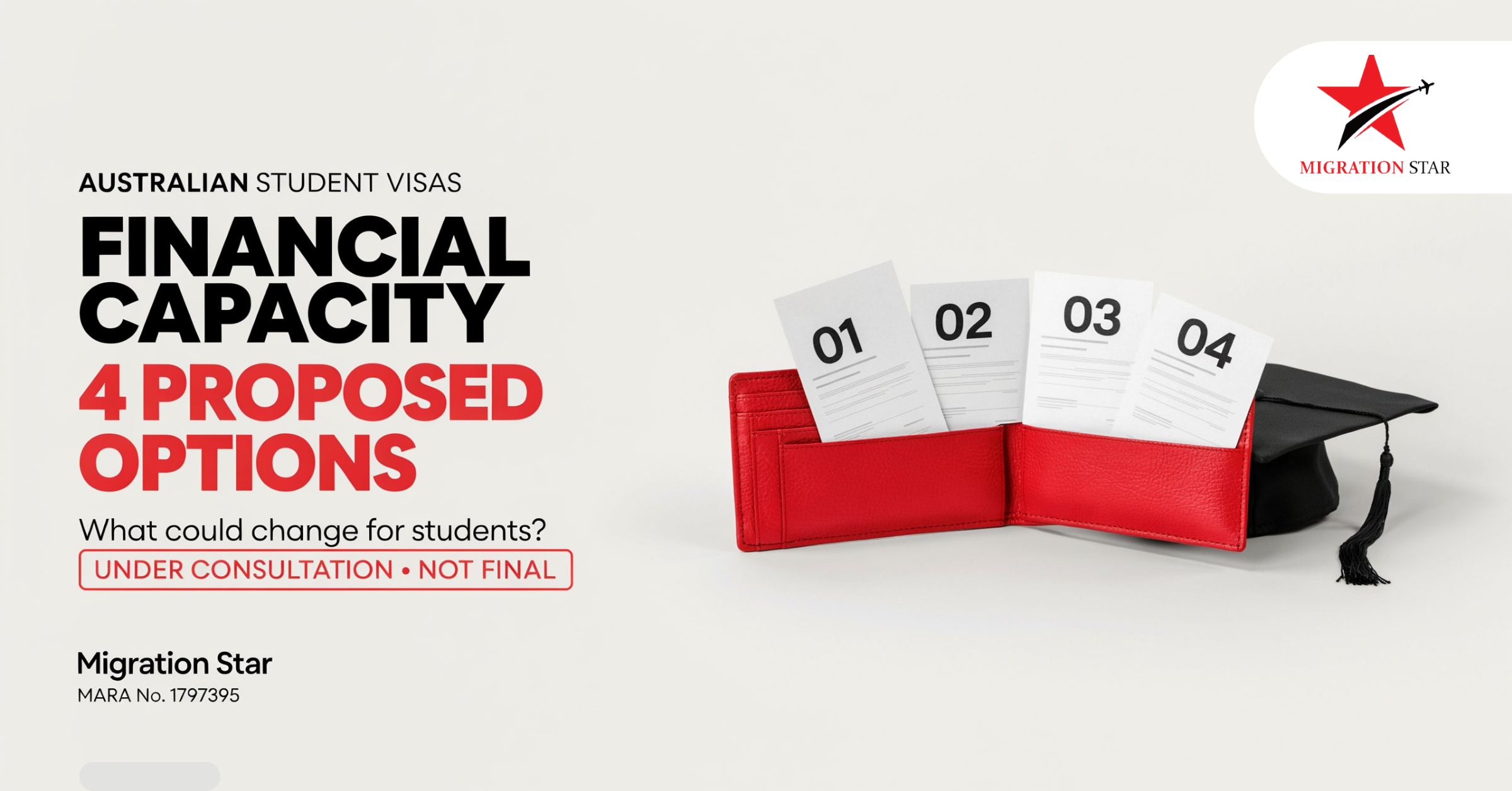
The consultation paper, Strengthening the Genuine Student requirement and financial capacity framework, sets out four options. The paper describes them as illustrative and not settled Departmental positions, so please read each one as a possibility only.
- Option 1, "Managed 50%": 50 per cent of total tuition and prescribed living costs for the full course, held in an Australian account for at least one month before lodgement, with funds released on a prescribed schedule.
- Option 2, "Flexible 50%": the same 50 per cent, held in an Australian account for at least three months, with no mandatory release schedule.
- Option 3, "First-year assurance": 100 per cent of tuition and prescribed living costs for the first 12 months, held in an Australian account for at least three months before lodgement. The paper says managed release could be targeted to defined cohorts.
- Option 4, "Recognised education finance": prescribed costs met through finance, personal funds, or both, with transfer to an Australian account preferred where practicable.
We have not quoted any dollar amounts here, because the consultation paper expresses the options as percentages of course costs.
The Australian bank account student visa proposal: what all four options share
Several features are common to every option in the paper. Each would require evidence of financial capacity when the visa application is lodged, and financial capacity would be assessed independently of provider Evidence Level settings. Prospective earnings from work in Australia would be excluded as a substitute for essential study and living funds.
Ownership, balance history and transactions would need to be verifiable. The paper also says genuine scholarships, government support and approved education finance would be recognised.
For many families this is the key practical point: the proposals focus on whether the funds are real, accessible and genuinely yours or your supporters', rather than only on the final balance on the day of application.
If you are searching for the likely student visa bank balance requirement in Australia, the honest answer today is that the paper offers different models with different holding periods and different shares of course costs. The Department has not chosen between them. Working out what each model could mean for your family is useful planning, but it should not be treated as a prediction.
The interim measure: Evidence Level 3 student visa financial evidence
Separate from the four options, the Department is consulting on an interim measure that would tighten financial evidence for primary applicants from Evidence Level 3 countries while longer-term reforms are considered. The paper says it would not predetermine which of the four options should ultimately proceed. We have not listed which countries are Evidence Level 3; check the current Department evidence-level information for your passport country.
As proposed, deposits would be supported by at least six months of transaction history, with a longer period in higher-risk cases. Reliance would generally be limited to the applicant, spouse, parents or another prescribed supporter. In the paper's words, "Unsecured personal lending and non-disbursed loans would generally not be accepted." The paper also says existing prescribed amounts would initially be retained.
Proposed Genuine Student changes: commencing versus continuing students
The consultation also canvasses a revised Ministerial Direction 106. The paper proposes to keep a holistic, individual assessment while focusing, for commencing students, on the credibility and achievability of the proposed study pathway. For continuing or returning students, it proposes greater weight on demonstrated conduct in Australia.
It also proposes positive weighting for transnational education pathways supported by evidence of progression and good outcomes, and removing reliance on formulaic Genuine Student statements. For background on today's rule, see our guide to the Genuine Student requirement. Home Affairs confirms the current requirement applies to applications lodged on or after 23/03/2024.
What to do before 23/11/2026, and how to plan a February 2027 application
First, keep applying the rules that exist today. Until the Department announces a decision, current requirements apply, and you should check them on the Department website before you lodge. Our offshore student visa checklist is a practical starting point.
Second, keep clean records. Whatever is eventually decided, verifiable ownership, a clear source of funds and transparent transaction history are sensible habits. Avoid last-minute lump-sum deposits you cannot explain. If a family member is supporting you, keep evidence of their relationship to you and of where their funds came from, as the paper contemplates supporters being limited to a defined group.
Third, consider making a submission. The Department accepts written submissions by email to student.visa.consultation@homeaffairs.gov.au with the subject line "Student Visa Consultation – sector/organisation". Include your name or organisation, contact details, the sector or cohort you represent and your responses to the consultation questions. The Department says it will not publish submissions or personal contact details.
You may also have read media reports quoting refusal rates. Home Affairs does not publish those figures in the consultation materials, so we have not used them. For what is officially reported, see our student visa grant rate guide.
Where Migration Star Can Help
Migration Star is a registered migration practice in Brisbane, and our principal agent is Rohit Sharma, MARA No. 1797395. We can talk through your study plans, your timing and the evidence you currently hold, and explain how the proposals may or may not affect you, subject to Department requirements. We cannot predict what the Government will decide or guarantee any visa outcome. Learn more about our services, call 07 3519 5619, or visit Level 2, 8 Clunies Ross Court, Eight Mile Plains QLD 4113. A 30-minute Migration Consultation ($165) can be booked at https://www.migrationstar.com.au/book-a-consultation
Information current as at 10/11/2026. Migration outcomes depend on individual circumstances. Visa criteria may change.
Information current as at 10/11/2026. Migration Star is a registered migration practice. Principal agent Rohit Sharma, MARA No. 1797395. Migration outcomes depend on individual circumstances. Visa criteria may change. This article is general information only and does not constitute migration advice. For advice on your specific situation, book a consultation at migrationstar.com.au.
Migration Star | MARA No. 1797395 | migrationstar.com.au | 07 3519 5619