%20(1).png?width=200&height=200&name=Untitled%20(200%20x%20200%20px)%20(1).png)
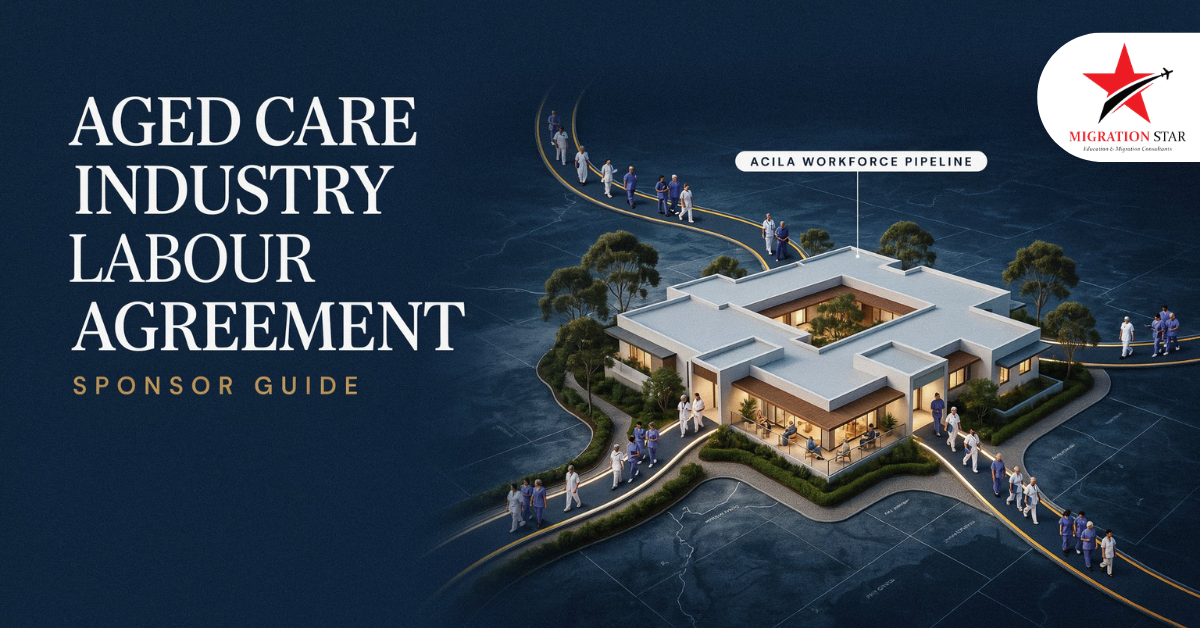
How Brisbane aged care providers sponsor Filipino, Indian and PNG direct-care workers under ACILA, including salary and English concessions, sponsor approval, and the 482 Labour Agreement workflow.
Aged care in Brisbane is growing, and so is the gap between residents needing direct care and the registered workforce available to provide it. For providers who have exhausted local recruitment, the Aged Care Industry Labour Agreement, or ACILA, is the permanent home for sponsoring direct-care workers from overseas. Operating under the Subclass 482 Skills in Demand visa Labour Agreement stream, ACILA gives providers a set of concessions and a streamlined application path. This article explains what ACILA is, the concessions that matter, the workers who qualify, and the workflow a Brisbane provider follows from sponsor approval through to a granted visa.
What the Aged Care Industry Labour Agreement is
The Aged Care Industry Labour Agreement is an industry labour agreement administered by the Department of Home Affairs. It sets fixed terms and conditions for sponsoring overseas direct-care workers into the Australian aged care sector where appropriately qualified Australians are not available. Approved providers sign the agreement and then nominate workers under the Subclass 482 Skills in Demand visa Labour Agreement stream.
ACILA replaced the prior interim Aged Care Industry Labour Agreement and has been positioned by the Department as the permanent route for direct-care worker sponsorship in this sector. It sits within the broader framework of industry labour agreements, alongside agreements covering meat, horticulture and other sectors with structural workforce challenges.
As Home Affairs explains, the agreement "streamlines the recruitment of qualified direct care workers from overseas to work in the aged care sector" where Australians are not available. You can read the full Department guidance on the Aged Care Industry Labour Agreement page.
The concessions that matter for direct-care worker sponsorship
ACILA carries three concessions that change the economics of recruitment for many Brisbane providers.
The first is the salary floor. Direct-care workers nominated under ACILA are sponsored at the Aged Care Industry Award rate, or the Annual Market Salary Rate where it is higher, rather than the standard Core Skills Income Threshold that applies to non-labour-agreement Subclass 482 nominations. Current figures are published in the labour agreement template at immi.homeaffairs.gov.au. The floor still moves with awards, but it is not pegged to the rising Core Skills figure that applies outside the labour agreement.
The second is the English language. ACILA recognises that direct-care workers who speak a community language fluently can deliver culturally and linguistically appropriate care to residents from the same background. Providers sponsoring workers for roles that genuinely require a community language can access English concessions, subject to the terms of the signed labour agreement and Department requirements.
The third is work experience. The standard Subclass 482 nomination expects evidence of relevant post-qualification work experience for many occupations. ACILA includes a work-experience concession for direct-care workers, reflecting that overseas qualifications and shorter relevant experience can produce a competent direct-care worker for the Australian setting.
Who qualifies as a direct care worker?
ACILA is for direct-care workers. The Department's definition centres on roles whose primary purpose is the hands-on care of aged care recipients. That includes personal care workers, assistants in nursing and registered nurses working in aged care settings. It does not include administrative, kitchen, maintenance or management roles, even where those roles are essential to running an aged care facility.
For providers, the practical filter is straightforward. If the position description and day-to-day duties focus on direct resident care, ACILA is likely the right pathway. If the duties are split between care and other functions, the role may not qualify under ACILA, and a standard Subclass 482 Skills in Demand visa or a different sponsorship route would be more appropriate.
Workers nominated under ACILA must meet the qualification, registration and police-check requirements that apply to direct-care work in Australia generally, including Aged Care Quality and Safety Commission worker screening. The Department's Aged Care Industry Labour Agreement page sets out the eligible occupations and the conditions of the agreement.
The provider-side workflow: sponsor approval to nomination
The pathway from intention to nominated worker has four steps.
Step one is the labour agreement itself. The provider signs the Aged Care Industry Labour Agreement with the Department. This is not the same as a standard business sponsorship; it is an industry-specific agreement that brings the ACILA concessions into the relationship. The provider must demonstrate genuine operations in aged care, financial capacity to support sponsorship, and a record of compliance with Australian workplace and aged care laws.
Step two is becoming an approved sponsor under the labour agreement. The provider lodges a sponsorship application referencing the signed labour agreement. Approval establishes the provider as an entity entitled to nominate workers under ACILA terms.
Step three is the nomination. For each role, the provider lodges a nomination naming the worker, the position and the salary on offer. Labour Market Testing requirements applicable under the labour agreement still apply, although the structure of the agreement recognises the industry-wide workforce shortage that justified it.
Step four is the worker's Subclass 482 Skills in Demand visa application under the Labour Agreement stream. The worker submits qualifications, registration evidence, identity and character documents, and health checks. Once granted, the worker may commence employment with the sponsoring provider in the nominated role, subject to all visa conditions and Department requirements.
The 482 to 186 PR pathway under the labour agreement
For many Brisbane providers, the question is not just how to bring a worker in but how to keep one. The Subclass 186 Employer Nomination Scheme has a Labour Agreement stream that mirrors the ACILA nomination pathway at the permanent residence stage.
The worker is nominated by the same approved provider, under the same labour agreement, for the same occupation. Work experience requirements, English requirements and age limits at the Subclass 186 stage are governed by the terms of the labour agreement and the Migration Regulations 1994. In practice, the Subclass 186 stream becomes available after the worker has spent the required time in the role, subject to meeting all criteria and Department requirements.
This permanent residence pathway is one reason ACILA is attractive to providers planning longer-term workforce stability. A direct-care worker sponsored under ACILA is on a route that can lead to permanent residence, subject to ongoing compliance with the agreement's standards. The Department's Labour Agreement stream of Subclass 186 page sets out the full requirements.
Where Migration Star Can Help
Migration Star advises Brisbane aged care providers through the full ACILA pathway, from labour agreement negotiation to sponsorship approval, individual nominations and the eventual Subclass 186 transition. Principal agent Rohit Sharma, MARN 1797395, has supported providers recruiting from the Philippines, India and Papua New Guinea, with attention to the documentation case officers expect to see. Your provider context may be eligible for the ACILA pathway, subject to meeting criteria and Department requirements. To discuss your situation, book a free written eligibility assessment, or schedule a 30-minute Migration Consultation for $165 at our Eight Mile Plains office.
- Phone: 07 3519 5619
- Address: Level 2, 8 Clunies Ross Court, Eight Mile Plains QLD 4113
Free written eligibility assessment: https://www.migrationstar.com.au/eligibility-assessment
Book a consultation (30 minutes AUD 165 or 1 hour AUD 330, incl GST, credited against our fees): https://www.migrationstar.com.au/book-a-consultation
You can also browse our migration services or book a session directly.
Information current as at 15/06/2026. Migration Star is a registered migration practice. Principal agent Rohit Sharma, MARN 1797395. Migration outcomes depend on individual circumstances. Visa criteria may change. This article is general information only and does not constitute migration advice. For advice on your specific situation, book a consultation at migrationstar.com.au.